- English
- Español
- Português
- русский
- Français
- 日本語
- Deutsch
- tiếng Việt
- Italiano
- Nederlands
- ภาษาไทย
- Polski
- 한국어
- Svenska
- magyar
- Malay
- বাংলা ভাষার
- Dansk
- Suomi
- हिन्दी
- Pilipino
- Türkçe
- Gaeilge
- العربية
- Indonesia
- Norsk
- تمل
- český
- ελληνικά
- український
- Javanese
- فارسی
- தமிழ்
- తెలుగు
- नेपाली
- Burmese
- български
- ລາວ
- Latine
- Қазақша
- Euskal
- Azərbaycan
- Slovenský jazyk
- Македонски
- Lietuvos
- Eesti Keel
- Română
- Slovenski
- मराठी
- Srpski језик

ENGINEER TALKS Ep.03: Boat Anchor Chain vs. Rope (Rode Sizing): 316SS Chain, Scope & Load Limits
At Andy Marine, we believe that practical manufacturing knowledge is one of the most valuable assets built over time.
Inside our workshop, there are engineers, production specialists, and experienced technicians who have spent years working with stainless steel marine hardware — from material selection and casting processes to finishing and quality control.
Many of these insights are learned through daily production experience: understanding why a component fails, how different materials perform in marine environments, and what details truly matter when developing reliable hardware.
However, this practical knowledge is often shared only within the workshop and rarely reaches customers who are making sourcing and engineering decisions.
ENGINEER TALKS is our effort to organize these conversations and share the manufacturing experience behind marine hardware.
Through this series, we discuss materials, production processes, design considerations, and real-world lessons from the perspective of a marine hardware manufacturer.
Today's ENGINEER TALKS Ep.03 is presented by Engineer Wu, written by me the editor.
1. Intro
When specifying ground tackle for yachts, commercial vessels, or shipyard builds, evaluating anchor chain versus synthetic rope is not a matter of selecting one over the other.
In mechanical terms, chain and rope fulfill entirely distinct, complementary roles within an anchoring system. From our experience manufacturing stainless steel deck hardware and ground tackle components at Andy Marine, effective anchoring requires balancing catenary weight, shock absorption, abrasion resistance, and deck load management.
Instead of treating chain and rope as mutually exclusive options, engineering and purchasing teams must evaluate how their structural properties interact under working loads to specify the correct configuration—all-chain, all-rope with a lead chain, or a hybrid rode.
2. Catenary Effect & Load Transfer Dynamics
The catenary curve determines how force is transmitted from the vessel to the anchor shank. The primary difference between chain and rope in this phase is mass per unit length.
All-Chain Rode
Heavy mass creates a catenary curve → keeps the pull vector parallel to the seabed
Synthetic Rope
Light mass under tension → pulls straight → may lift the anchor shank
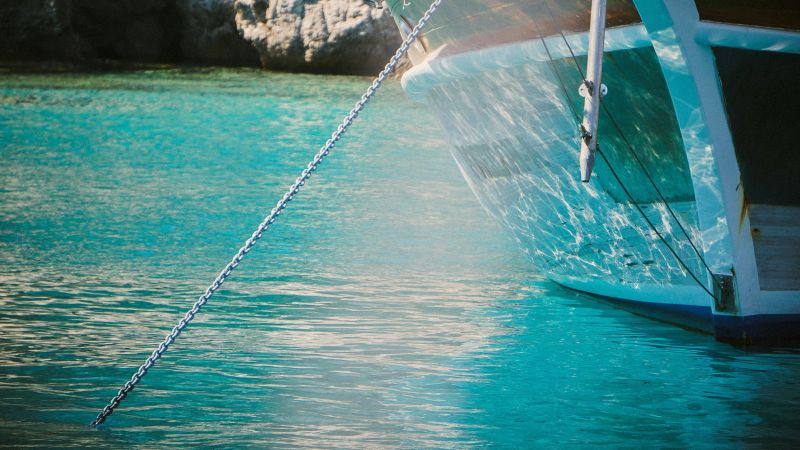
Anchor Chain Behavior
- Mechanics: Because steel chain has high linear mass, gravity pulls the submerged line downward into a pronounced catenary curve.
- Seabed Impact: This curve forces the line of pull at the anchor shank to remain virtually parallel to the seabed (typically under 5 degrees), enabling modern plow, spade, or fluke anchors to maintain set and dig deeper as tension increases.
- Load Damping: Under mild to moderate wind and current, energy is dissipated simply by lifting the heavy links off the seabed before the force ever reaches the anchor.
Synthetic Rope Behavior
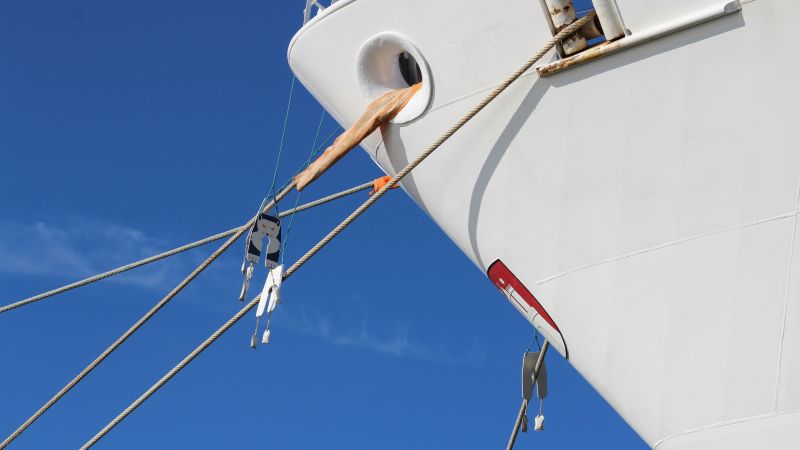
- Mechanics: Synthetic rope is lightweight and near-neutral in buoyancy compared to steel. Under light-to-moderate tension, it loses its sag and forms a direct, straight line from bow roller to anchor.
- Seabed Impact: Without heavy mass, a pure rope rode creates a higher vertical pull angle at the shank, which can unseat the anchor during surge.
- Engineering Requirement: Rope must always be paired with a heavy lead chain directly attached to the anchor shank to maintain a low angle of pull.
3. Dynamic Shock Absorption & Peak Load Dissipation
Once environmental forces (swell, gusts, wave action) pull the rode completely taut, the system's mechanical elasticity becomes the primary defense against hardware failure.
Performance Comparison Table
| Performance Factor | Anchor Chain | Synthetic Rope (e.g., Nylon) |
|---|---|---|
| Material Elasticity | Near zero elongation under working loads | High elastic elongation (15%–28% before yield) |
| Energy Dissipation Method | Gravitational potential (lifting catenary mass) | Mechanical stretching (fiber elongation) |
| Behavior at Taut Limit | Becomes rigid; transfers shock directly to deck | Acts as a spring; dampens peak impulse forces |
| Hardware Strain Risk | High risk of anchor breakout or deck fitting deformation | Reduced stress on cleats, bow rollers, and windlasses |
Anchor Chain Behavior
Once the catenary curve is pulled flat by heavy swell, chain offers zero shock absorption. The rigid steel transfers dynamic peak loads straight to the bow roller, chain stopper, and anchor point.
Mitigation: All-chain setups require an external elastic element—such as a nylon snubber line or bridle attached with a chain hook—to absorb peak dynamic loads.
Synthetic Rope Behavior
Multi-strand or 8-plait nylon rope acts as a natural mechanical damper. Its high elongation absorbs impulse energy from wave impacts, smoothing out load spikes.
Mitigation: While excellent for dampening, excessive cycling near peak elongation can cause internal friction heat and long-term fatigue in synthetic fibers, requiring proper line sizing.
4. Seabed Abrasion & Environmental Resistance
The bottom section of any ground tackle operates in a high-wear environment, coming into direct contact with sand, coral, rocks, and debris.
Anchor Chain Behavior
- Abrasion Resistance: High-tensile carbon steel or 316 stainless steel chain provides superior resistance to localized cutting, grinding, and cyclic friction.
- Durability: It maintains structural integrity when dragged across jagged underwater terrain, making it essential for the lower portion of any anchoring line.
Synthetic Rope Behavior
- Abrasion Resistance: Synthetic fibers (nylon, polyester) suffer swift tensile strength degradation when dragged over sharp rocks or coral under load.
- Durability: Surface chafing rapidly severs outer strands, leading to premature line failure.
- Protection Strategy: Rope should remain suspended off the seabed during normal deployment, relying on the lead chain to handle ground contact.
5. Deck Hardware & System Integration Requirements
Specifying chain versus rope dictates the engineering requirements for deck hardware, storage lockers, and load-bearing components on the vessel.
Chain-Primary Systems
- Windlass Requirements: Requires a dedicated, precision-machined windlass gypsy precisely matched to the link calibration (e.g., DIN 766 or ISO short-link).
- Load Isolation: All-chain setups generate high static holding loads. A dedicated deck-mounted chain stopper or pawl is required to transfer load off the windlass shaft and motor drive.
- Storage & Weight: Requires a deep, reinforced chain locker located low in the hull to handle concentrated weight and allow natural flake-out during retrieval.
Rope & Hybrid Systems
- Windlass Requirements: Requires a dual-purpose combination gypsy/drum capable of gripping both the calibrated chain links and the rope-to-chain splice without jamming.
- Load Isolation: Working loads are secured directly to structural deck cleats or Samson posts using standard line hitches or stoppers.
- Storage & Weight: Significantly reduces bow weight, improving vessel trim and performance on light displacement or high-speed craft.
Connecting Hardware
Both configurations depend on reliable intermediate components to join sections and prevent hockling:
- Stainless Steel Swivels: Installed between the anchor and chain to eliminate line twisting during retrieval and ensure smooth entry into the bow roller.
- Precision Shackles & Thimbles: Used at the chain-to-rope splice transition to prevent chafing and maintain rated break strength across dissimilar materials.
Andy Marine provides OEM/ODM stainless steel marine hardware solutions, supporting custom bow rollers, chain stoppers, swivels, deck cleats, and structural cast components for yacht builders, equipment distributors, and marine manufacturers.
Contact our engineering team to review technical drawings, material specifications, and production requirements for your ground tackle projects.