- English
- Español
- Português
- русский
- Français
- 日本語
- Deutsch
- tiếng Việt
- Italiano
- Nederlands
- ภาษาไทย
- Polski
- 한국어
- Svenska
- magyar
- Malay
- বাংলা ভাষার
- Dansk
- Suomi
- हिन्दी
- Pilipino
- Türkçe
- Gaeilge
- العربية
- Indonesia
- Norsk
- تمل
- český
- ελληνικά
- український
- Javanese
- فارسی
- தமிழ்
- తెలుగు
- नेपाली
- Burmese
- български
- ລາວ
- Latine
- Қазақша
- Euskal
- Azərbaycan
- Slovenský jazyk
- Македонски
- Lietuvos
- Eesti Keel
- Română
- Slovenski
- मराठी
- Srpski језик

ENGINEER TALKS Ep.09: Marine Hatch Hardware Failure Analysis: Hinges & Latches
At Andy Marine, we believe that practical manufacturing knowledge is one of the most valuable assets built over time.
Inside our workshop, there are engineers, production specialists, and experienced technicians who have spent years working with stainless steel marine hardware — from material selection and precision investment casting to machining, polishing, and assembly line quality control.
Many of these insights are learned the hard way through daily production and field returns: understanding why a latch binds after a season on the water, why a hinge snaps at the knuckle under wave impact, and what subtle foundry and assembly details prevent costly warranty claims.
However, this practical knowledge is often kept within the workshop and rarely reaches the boatbuilders, naval architects, and purchasing managers who make critical sourcing decisions.
ENGINEER TALKS is our effort to share this real-world manufacturing experience.
Through this series, we discuss materials, tooling, production processes, and candid shop-floor lessons from the perspective of a dedicated marine hardware manufacturer.
Today's ENGINEER TALKS Ep.09 is presented by Engineer Wu, written by me the editor.
In boatbuilding and hardware procurement, when a deck fitting fails, the immediate reaction is often to blame the material grade—assuming someone supplied inferior stainless steel or skipped on corrosion protection.
Yet, after examining countless returned deck fittings from shipyards and warranty service centers, our workshop team sees a very different reality. Hatch hardware—specifically deck hinges, slam latches, turning locks, and flush-mount pull rings—rarely fails from general rusting alone. Instead, premature failures on the water are almost always driven by mechanical and geometric realities: water-trapping pockets that starve the steel of oxygen, sharp internal casting corners that concentrate wave-slamming shock, uneven wall thickness causing hidden internal porosity, and undersized mounting interfaces that tear into composite deck cores.
Marine hatches operate in one of the most punishing zones on any vessel. They are walked on, slammed shut under heavy seas, doused in salt spray, and scrubbed with aggressive wash-down chemicals. When hardware is selected based purely on a shiny catalog photo without evaluating how it handles real dynamic loads and drainage, failure is only a matter of time.
This guide shares our practical workshop observations on why hatch hardware breaks down in service, and what boatbuilders, designers, and assembly supervisors should look for to eliminate these risks before components reach the production line.

1. Deck Hinges: Fatigue Fractures, Water Traps, and the Danger of Sharp Corners
Deck hinges on heavy engine hatches, lazarettes, and livewells endure continuous cyclic stress. Every time a vessel slams into a head sea, the entire mass of the hatch lid exerts a violent cantilever leverage force straight into the hinge base and knuckle pin. When inspecting broken hinges returned from the field, failures almost invariably concentrate at two specific spots: the knuckle junction and the mounting screw recess.
The "Water Trap" Phenomenon:
Grade 316 stainless steel relies on continuous contact with dissolved oxygen in ambient air to maintain and heal its microscopic chromium oxide protective film. When a hinge casting is designed with flat, recessed mounting pockets or tight, un-drained knuckle gaps, wash-down water and salt spray pool inside. Trapped in a stagnant, oxygen-deprived pocket, the steel cannot rebuild its passive layer. The stagnant saltwater turns acidic, initiating localized crevice corrosion and pitting that quickly acts as an invisible starting point for fatigue cracks under repeated dynamic wave slam.
Sharp Internal Corners vs. Generous Fillets:
In low-cost sand castings or poorly tooled investment molds, the transition between the flat mounting flap and the raised knuckle is often left with a sharp right angle. Dynamic impact loads concentrate directly along this sharp notch line rather than dispersing across the body. Well-tooled investment cast hinges incorporate smooth, continuous transition radii and sloped drainage planes to distribute shock loads evenly while allowing seawater to run off immediately.
Casting Wall Thickness Balance:
In the foundry, if the hinge knuckle is cast thick and solid while the mounting flap remains paper-thin, the metal cools unevenly in the ceramic mold. This cooling differential creates hidden microscopic shrinkage voids right at the junction where stress is highest. Proper tooling ensures uniform wall transitions, eliminating internal casting voids before polishing begins.

Hinge
Cast stainless steel hinges for marine hatches, lockers, and deck access panels.
VIEW CASTING HINGES →2. Slam Latches & Turning Locks: Spring Degradation and Mechanical Binding
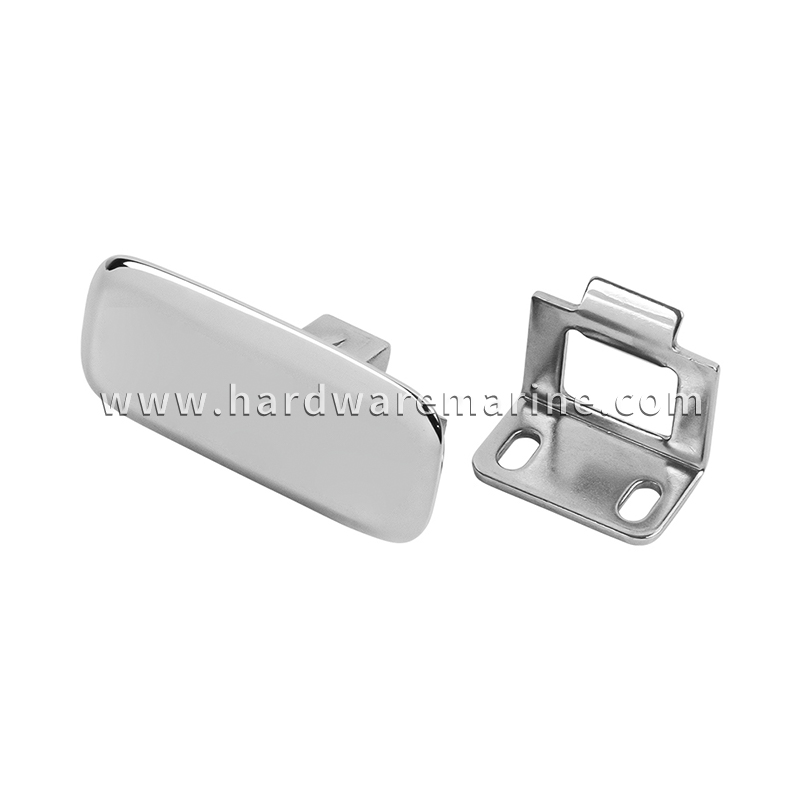
Latching mechanisms on floor hatches, center console doors, and baitwells endure thousands of closing slams and continuous hull vibration underway. The two most common field complaints from boatyards are "the latch tongue is jammed inside and won't pop out" and "the turning lock is rattling loose and won't seal the hatch."
Why Slam Latches Bind Up:
- Internal Spring Chamber Corrosion: While the outer latch body is cast 316 stainless steel, internal compression springs are frequently made from inferior spring wire. When unsealed latch chambers trap saltwater, the spring suffers rapid relaxation or snaps entirely, leaving the sliding bolt stuck inside.
- Rough As-Cast Cam Bevels: If the beveled engagement face of the sliding bolt is left rough or only superficially buffed, repeated slamming against the strike plate creates micro-galling, causing metal-on-metal friction that quickly binds the mechanism.
Why Turning Locks Lose Compression:
- Shaft Play & Eccentric Wear: When the clearance between the central rotation shaft and the housing is too loose, engine vibration causes the shaft to wobble. Over time, the cam arm wears unevenly against the strike plate, stripping the internal drive and losing compression on the hatch gasket.
- Lack of Positive Detents: Without positive ball-detent positioning or synthetic locking bushings, continuous running vibration gradually rotates the latch handle off its locked position, letting water leak into dry storage compartments.
Slam Latch
Spring-loaded latches for securing hatches, doors, and compartment covers.
VIEW SLAM LATCHES →3. Flush-Mount Pull Rings: Snatch Loads and Deck Tear-Out
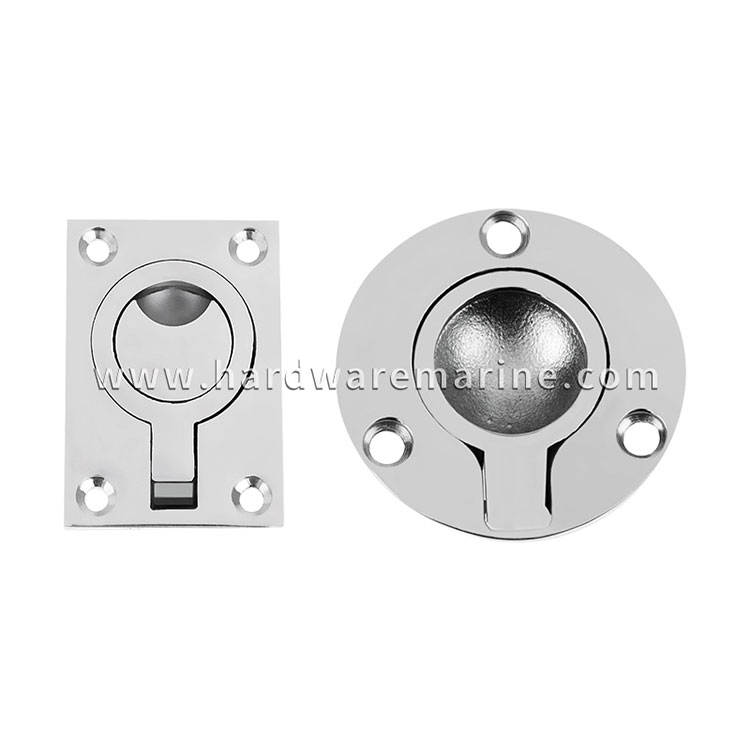
Flush pull rings are designed to sit perfectly flat on high-traffic deck areas while allowing crew members to lift heavy, gasketed floor panels, livewells, and engine room hatches. However, lifting a heavy hatch sealed tight with rubber creates high initial breakout resistance. Crew members rarely pull straight upward with calibrated force; they jerk and snatch the ring at an angle.
The Vulnerability of Single-Point Pivot Pins: A flush pull ring pivots on a horizontal retention pin inside the cast cup. When undersized pins or shallow retention bosses are used, angled snatch loads bend the pin, jamming the ring half-open or shearing the pin under heavy loads.
Deck Core Crushing & Gelcoat Cracking: The second major failure point is the deck interface. Standard flush cups have narrow perimeter flanges. When someone yanks hard on the ring, the upward force creates a severe levering action, driving the outer flange edge downward like a chisel into the fiberglass gelcoat. Fastening pull rings directly into composite decks with sheet metal screws without wide backing plates inevitably crushes the core, cracks the gelcoat, and causes moisture intrusion into the deck laminate.
4. Foundry & Finishing Details: Where Hardware Reliability is Really Built
Walking through our casting workshop, you quickly learn that the difference between a fitting that lasts ten seasons and one that fails in twelve months comes down to operations that the naked eye often overlooks on a finished part.
- Complete Deflashing Along Parting Lines: Where ceramic mold halves meet, microscopic casting flash forms along the parting line. If finishing workers simply buff the exterior and leave rough flash inside hinge knuckles or screw countersinks, those jagged edges act as built-in stress risers where fatigue cracks begin, while trapping buffing dust that rapidly rusts.
- Full Ultrasonic Cleaning and Chemical Passivation: A high-gloss mechanical mirror polish alone does not guarantee corrosion resistance—buffing wheels can smear microscopic iron particles and wax into surface micro-valleys. True marine durability requires full ultrasonic degreasing followed by thorough chemical acid passivation to dissolve free iron and restore an unbroken, self-healing passive layer across all interior and exterior surfaces.
5. Shop-Floor Quality & Acceptance Checklist for Boatbuilders
To help yacht assembly supervisors, quality inspectors, and procurement teams screen out high-risk hatch hardware before installation, our engineering team recommends this practical 4-step physical inspection protocol:
| Inspection Focus | What to Check With Hand & Eye | Why It Matters on the Boat |
|---|---|---|
| 1. Corner Radii & Drainage | Check the junction between knuckle and mounting flap. Look for smooth, generous transition curves and sloped fastener recesses rather than sharp right angles. | Eliminates stress concentration points under wave slam; prevents standing water from rotting the protective passive film. |
| 2. Moving Part Tolerance & Feel | Operate slam latches and turning locks by hand. Check for positive, snappy spring return without rough friction, and ensure turning shafts do not have loose lateral wobble. | Loose shafts rattle open under engine vibration; rough latch tongues gall and bind after brief saltwater exposure. |
| 3. Flange Underbody & Pin Strength | Inspect the back of pull rings and hinge flaps. Verify adequate wall thickness, presence of underside reinforcing ribs, and heavy, secure pin retainers. | Prevents cast housings from flexing or snapping pivot pins when crew snatch heavy, suctioned hatch covers open. |
| 4. Fastener Backing & Bedding Fit | Ensure mounting screw countersinks are cleanly centered without burrs, and verify that thru-bolt backing plates are specified for all structural hatch pull points. | Distributes dynamic shock loads evenly into the hull structure, preventing gelcoat cracking, screw pull-out, and deck core crushing. |
6. Sourcing Hardware Built for Real Marine Duty
Hatch hardware should never be an afterthought in vessel design. When a hinge snaps, a latch seizes, or a pull ring pulls out on the water, the boat owner does not care what brand of hardware was installed—they hold the boatbuilder accountable for the failure. By insisting on hardware engineered with proper stress-relieving radii, self-draining contours, robust internal mechanisms, and clean foundry finishing, boatbuilders can protect their brand reputation, streamline assembly line fitment, and eliminate costly warranty service calls.
Custom Marine Hardware Engineering and OEM Manufacturing
Andy Marine specializes in OEM and ODM stainless steel marine hardware solutions, partnering with yacht builders, naval architects, and marine distributors worldwide.
From design-for-manufacturing (DFM) reviews and custom tooling development to precision investment casting, multi-axis CNC machining, electropolishing, and batch testing, our engineering team works directly with your technical staff to ensure every hatch fitting, hinge, and locking mechanism performs reliably under real ocean loads.
Contact our engineering department today to review your deck hardware specifications or discuss custom tooling requirements for your next production build.