- English
- Español
- Português
- русский
- Français
- 日本語
- Deutsch
- tiếng Việt
- Italiano
- Nederlands
- ภาษาไทย
- Polski
- 한국어
- Svenska
- magyar
- Malay
- বাংলা ভাষার
- Dansk
- Suomi
- हिन्दी
- Pilipino
- Türkçe
- Gaeilge
- العربية
- Indonesia
- Norsk
- تمل
- český
- ελληνικά
- український
- Javanese
- فارسی
- தமிழ்
- తెలుగు
- नेपाली
- Burmese
- български
- ລາວ
- Latine
- Қазақша
- Euskal
- Azərbaycan
- Slovenský jazyk
- Македонски
- Lietuvos
- Eesti Keel
- Română
- Slovenski
- मराठी
- Srpski језик

ENGINEER TALKS Ep.11: Boat Swim Ladder Mounting & Transom Backing: Telescoping 316SS Ladder Guide
At Andy Marine, we believe that practical manufacturing knowledge is one of the most valuable assets built over time.
Inside our workshop, there are engineers, production specialists, and experienced technicians who have spent years working with stainless steel marine hardware — from material selection and precision investment casting to machining, polishing, and assembly line quality control.
Many of these insights are learned the hard way through daily production and field returns: understanding why a latch binds after a season on the water, why a hinge snaps at the knuckle under wave impact, and what subtle foundry and assembly details prevent costly warranty claims.
However, this practical knowledge is often kept within the workshop and rarely reaches the boatbuilders, naval architects, and purchasing managers who make critical sourcing decisions.
ENGINEER TALKS is our effort to share this real-world manufacturing experience.
Through this series, we discuss materials, tooling, production processes, and candid shop-floor lessons from the perspective of a dedicated marine hardware manufacturer.
Today's ENGINEER TALKS Ep.11 is presented by Engineer Wu, written by me the editor.
In marine warranty service records, structural damage around swim platforms and boarding ladders is one of the most persistent customer complaints facing boatbuilders and shipyards.
When inspecting cracked gelcoat, loose mounting fasteners, or leaking transoms, the primary breakdown is rarely a fractured stainless steel ladder. Instead, the failure traces directly to the mechanical interface: a lightweight composite laminate struggling to endure concentrated, cyclic cantilever loads without adequate structural backing or proper compression isolation.
This guide shares our practical workshop observations on the physics of swim ladder mounting, explores the structural failure paths of cored composites, and provides a field-proven four-step shipyard reinforcement protocol to protect both vessel longevity and passenger safety.
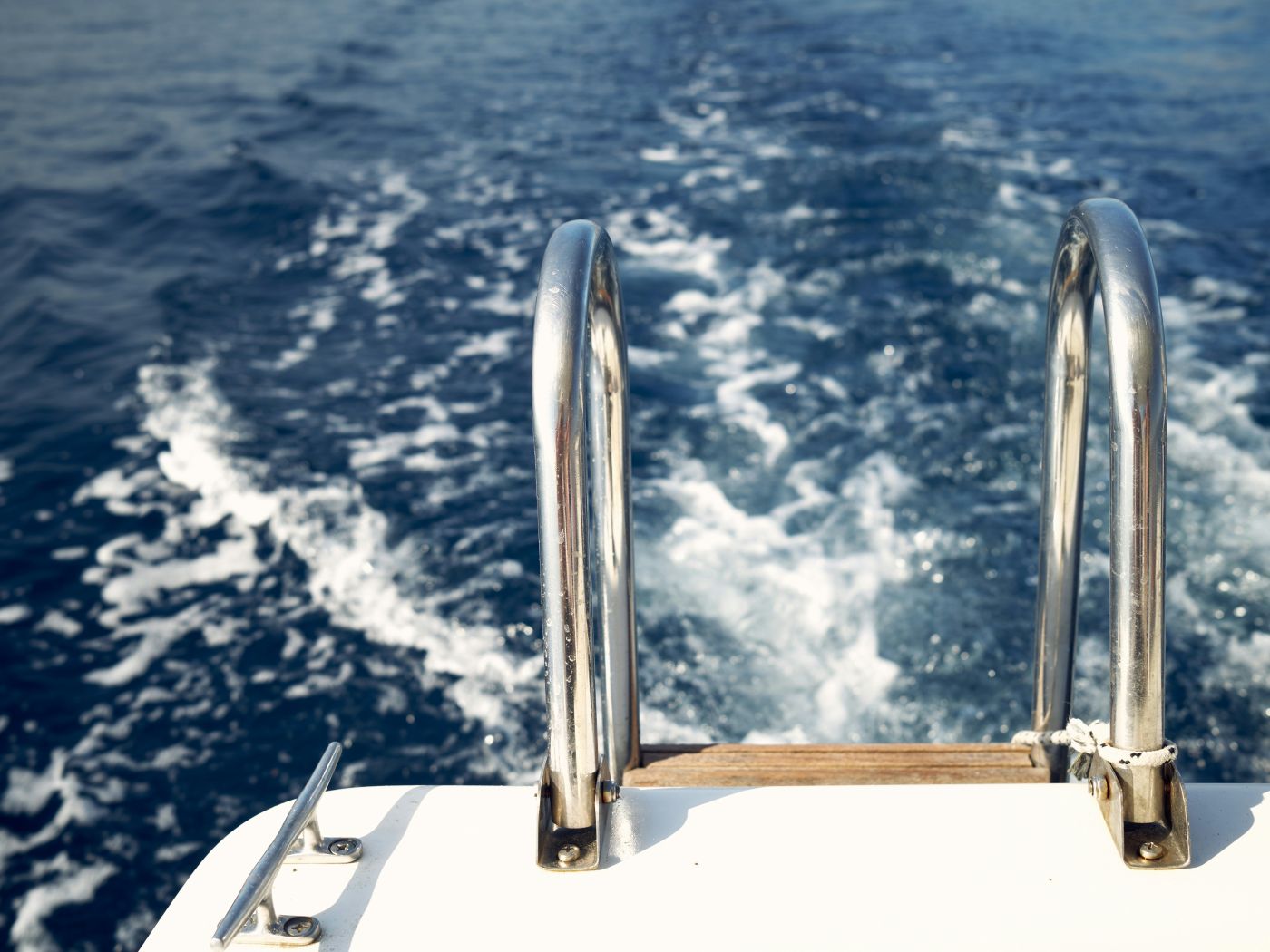
1. The Mechanical Reality of Transom Mounting: A Massive Cantilever in Action
When a swimmer climbs onto a boat from the water, the boarding ladder functions as a powerful mechanical lever. Understanding the magnitude and orientation of these forces is essential for designing a durable, crack-free mounting interface.
When an adult swimmer—frequently weighed down with wet garments, fins, or heavy scuba gear—steps onto the lowest submerged rung, their entire body mass is applied at the end of an extended moment arm reaching deep into the water. Because the mounting bracket baseplate on the swim platform or transom occupies a relatively compact footprint, this geometry creates an extreme force multiplication effect.
The resulting forces acting on the mounting fasteners divide into two distinct vectors:
- Lower Fasteners & Base Contact Zone: Subjected to concentrated compressive loads and vertical shear, driving the bottom edge of the bracket directly into the composite skin.
- Upper Fasteners: Subjected to extreme dynamic tensile pull-out forces, attempting to pry the fastener heads straight through the deck laminate.
In active sea conditions, these static loads are heavily amplified by dynamic wave surging and vessel heave acting against the submerged ladder structure while the user is climbing. Without engineered backing and adequate load distribution, this cyclic cantilever torque will rapidly degrade even heavy composite laminates.
2. Interface Failure Modes: Cored Decks, Point Loads, and Sealant Degradation
In modern yacht construction, swim platforms and transom steps are frequently built using either solid fiberglass laminates or sandwich composite construction (incorporating end-grain balsa wood or structural PVC/PET foam cores). Each substrate exhibits distinct failure modes when subjected to concentrated point loads.
A. Sandwich Core Crushing (Loss of Fastener Preload):
The most prevalent assembly error in boatbuilding is drilling bolt clearance holes straight through a cored composite deck and tightening the fasteners against the outer skins. Low-density core materials lack compressive strength under concentrated bolt torque. When the mounting fasteners are tightened—or when the ladder experiences its first heavy boarding cycle—the core material crushes flat. Once the internal core collapses, the outer and inner fiberglass skins lose their structural separation, the mounting bolts lose their preloaded clamping tension, and the ladder base begins to flex noticeably under foot.
B. Point-Load Stress and Gelcoat Spider Cracking:
When builders rely on standard small-diameter flat washers on the underside of a thin laminate, the tensile pull-out force generated by the upper ladder hinge concentrates on a tiny contact area. Under cyclic dynamic rocking, the brittle outer cosmetic gelcoat cannot flex at the same rate as the underlying fiberglass laminate. It develops radial "spider cracks" around the fastener penetrations, which gradually progress into full interlaminar shear failure.
C. Sealant Shear and Internal Water Ingress (Rot):
Marine elastomeric sealants (polyurethane or hybrid polymers) require a continuous, flexible bond line to prevent water intrusion. As a loose ladder assembly rocks back and forth under dynamic cantilever loads, it creates micro-shear displacements across the baseplate footprint. This cyclic movement shears the sealant bond away from the gelcoat surface. Saltwater immediately migrates into the unsealed fastener penetrations. If the transom contains an unsealed balsa wood or plywood core, anaerobic water retention initiates rapid core rot, destroying the structural integrity of the transom within months.
3. Practical Shipyard SOP: The Four-Step Interface Reinforcement Protocol
To ensure a permanent, failure-free ladder installation that protects vessel warranty and passenger safety, professional yards implement a disciplined structural reinforcement protocol during deck rigging.
| SOP Step | Installation Control | Technical Mechanism & Value |
|---|---|---|
| 1. De-core & Potting | Radial core removal + thickened structural epoxy injection | Creates a solid composite bushing that prevents core crushing and forms a 100% waterproof barrier. |
| 2. Chamfered Backing Plate | Heavy-gauge 316 stainless or G10 plate with radiused edges | Spreads tensile pull-out loads across a broad area; prevents sharp corners from gouging the inner hull. |
| 3. Gelcoat Beveling | 45° countersink chamfer at hole entry | Eliminates stress concentration at the gelcoat edge; creates a reservoir for an elastomeric O-ring seal. |
| 4. Two-Stage Bedding | Hand-snug fasteners, allow skin-over cure, then final torque | Maintains an elastomeric gasket thickness (~1mm); prevents over-tightening from squeezing out all sealant ("dry joint"). |
Step 1: De-Coring and Structural Epoxy Potting (The Crush-Proof Bushing)
For cored decks, the core material must be isolated from the mechanical load path. Drill the initial pilot hole through the sandwich deck. Using a bent Allen key or specialized milling bit in a rotary tool, clear out the soft core material radially around the hole circumference between the two fiberglass skins. Seal the bottom of the hole with marine masking tape and inject thickened structural epoxy (epoxy resin mixed with high-density structural filler) into the void. Once fully cured, re-drill the fastener clearance hole through the solid epoxy center. This creates a solid composite bushing that cannot crush under bolt torque and forms an impenetrable barrier against water ingress into the core.
Step 2: Engineered Backing Plates with Radiused Edges
Never use standard fender washers on primary ladder hinge brackets. Install a dedicated, oversized backing plate made from heavy-gauge 316 stainless steel plate or structural G10 composite board. Crucially, the interior perimeter edges of the backing plate must be chamfered or radiused. If a backing plate has razor-sharp machined edges, it acts as a shear cutter against the inside fiberglass laminate when the transom flexes under extreme boarding torque. Radiused edges distribute the bending stress smoothly across the inner hull skin.
Step 3: Gelcoat Hole Beveling (Stress Relief & Gasket Cavity)
Before applying bedding compound, lightly countersink or chamfer the gelcoat surface at the top of each drilled hole at approximately 45°. This simple shop practice eliminates the sharp corner that frequently initiates gelcoat chipping when the fastener is inserted and creates an annular recess around the bolt shank that holds a thicker ring of sealant, forming a permanent elastomeric O-ring seal under the bracket base.
Step 4: Two-Stage Bedding Discipline (Preventing "Dry Joints")
A frequent assembly flaw is using an impact driver or high-torque ratchet to torque the mounting bolts immediately after applying wet sealant. This squeezes out virtually all adhesive from beneath the bracket base, creating a "dry joint" with zero elastic cushion. The best shop practice is to snug the fasteners down by hand just until the sealant beads evenly around the entire perimeter of the baseplate (maintaining a resilient gasket thickness of ~1mm). Allow the sealant to reach its initial cure and form an elastic rubber seal, then apply final torque to the backing plate locknuts.
4. Hardware Engineering: How Heavy-Duty Brackets Protect the Hull
Selecting the right marine ladder hardware directly influences how successfully the vessel's hull handles boarding loads over years of saltwater service.
Rigid Baseplate Geometry vs. Flimsy Stamped Sheet:
Low-cost aftermarket ladders often utilize thin stamped stainless brackets. Under dynamic cantilever loads, thin brackets flex elastically, concentrating all bending strain directly onto the edge fasteners and prying the sealant loose. In contrast, Andy Marine ladders utilize heavy-gauge, CNC-machined or precision investment cast 316 stainless steel mounting lugs with reinforced weld gussets. The bracket acts as a rigid beam, transmitting the load across the entire backing plate evenly.
Under-Mount Swim Platform Ladders:
Under-mount telescoping ladders are preferred on modern sports cruisers and center consoles because they preserve clean deck aesthetics. However, because they reside in the active splash zone, their mounting housings must incorporate integrated drainage channels and generous mounting flange surfaces to prevent stagnant saltwater traps while ensuring multi-point load transfer to the platform stringers.

Boat Ladder
Heavy-duty 316 stainless steel telescoping and under-mount swim ladders engineered for OEM transom integration.
VIEW BOAT LADDERS →Custom Marine Hardware Engineering and OEM Manufacturing
Andy Marine specializes in OEM/ODM stainless steel marine hardware solutions, supporting yacht builders, naval architects, and commercial marine distributors worldwide.
From custom transom bracket engineering and design-for-manufacturing (DFM) reviews to precision investment casting, multi-axis CNC machining, structural TIG welding, electropolishing, and batch load testing, our technical team works closely with your engineering department to ensure every boarding system meets rigorous durability, safety, and fitment standards.
Contact our engineering team to discuss your custom ladder configurations, transom interface brackets, and precision backing plate requirements.